In a damp landscape, harvests had to be raised, ventilated and protected. The Galician hórreo is not a whimsical form: it is rural technology refined over generations. Carnota pushed that logic to monumental scale.
Architecture born from damp conditions
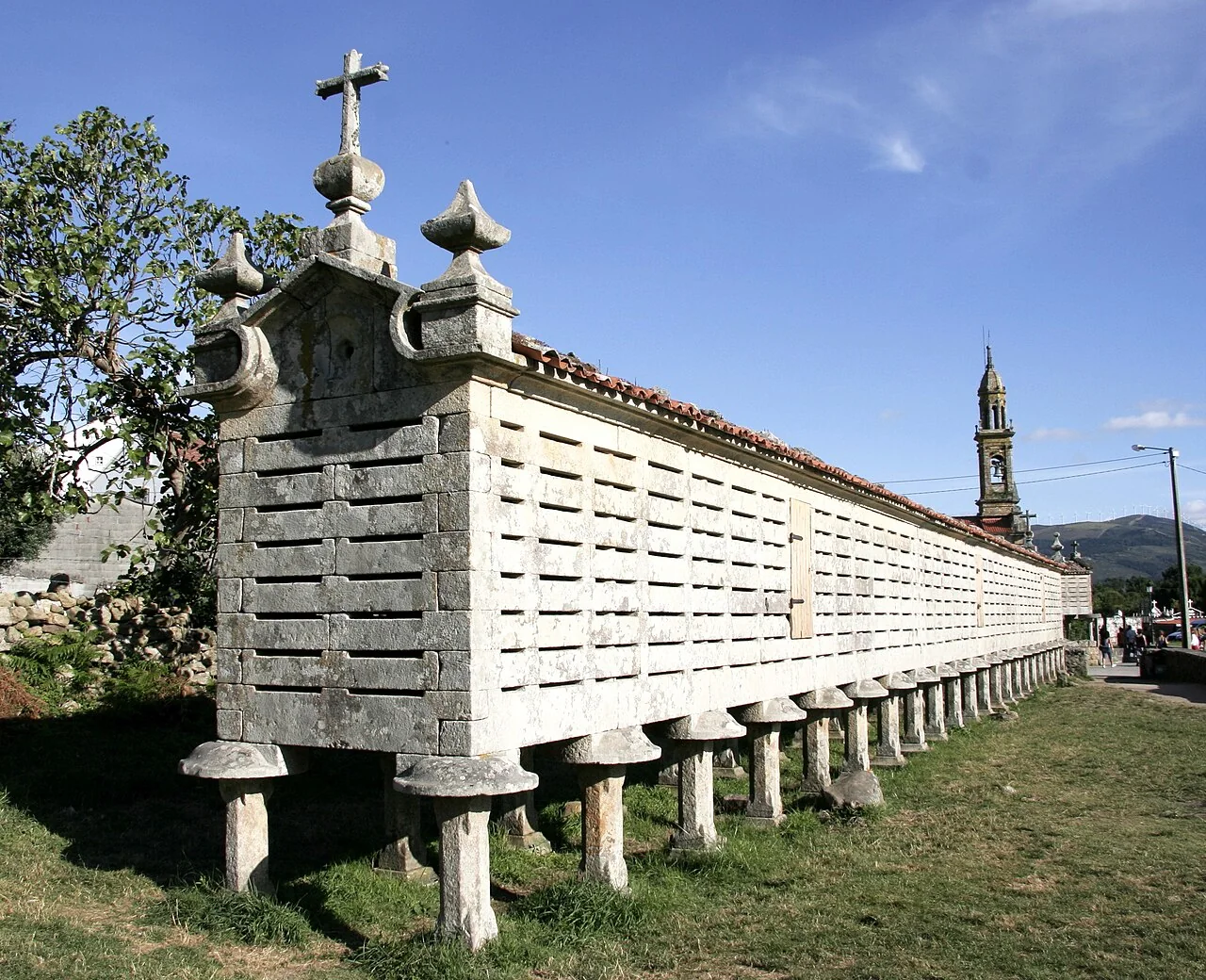
The hórreo stored, dried and preserved maize and other produce. Raising the chamber on granite feet separated food from the ground; broad stone caps obstructed animals and horizontal gaps kept air moving through the store.
In Carnota, the nearby marsh, rain and Atlantic air make the intelligence of this system easy to see. It does not imitate a house: it creates a narrow, elongated chamber crossed by air.
1768: eleven pairs of feet
The first phase was built in 1768 with eleven pairs of feet, roughly half its present extension. Its relationship with church and rectory shows that it was not a small household store but part of the parish economy.
1783: the rhythm doubles
Fifteen years later another eleven pairs were added. The extension created the sequence of twenty-two pairs that defines the building today and brought it to 34.76 metres long and 1.90 metres wide.
Santa Comba: religion, production and landscape
The Church of Santa Comba is dated to 1755 and described as Baroque-classicist. A bell tower and Neoclassical changes were added in the nineteenth century. With rectory, dovecote, threshing floor and hórreo, it creates a place where worship, administration and agricultural production overlap.
The best visit therefore goes beyond one photograph. Walk the edges of the ensemble and notice scale, materials, sightlines and former uses.
Carnota and Lira: two answers, one rivalry
The nearby Hórreo de Lira was built between 1779 and 1814. It is longer, but narrower and raised on a stone platform to adapt to sloping ground. The comparison shows why "the largest" cannot be reduced to one number.
| Aspect | Carnota | Lira |
|---|---|---|
| Construction | 1768 extended in 1783 | 1779–1814 |
| Length | 34.76 m | 36.53 m |
| Width | 1.90 m | 1.60 m |
| Supports | 22 pairs of feet | 22 pairs of feet |
| Setting | Santa Comba ensemble | Platform adapting to the slope |